
Donate
MENU
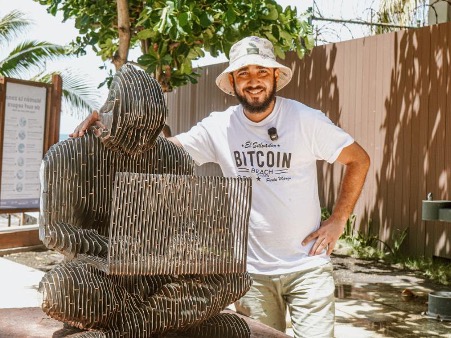
The Fellowship Program is one of the fundamental pillars through which Bitcoin Beach supports Bitcoin circular economies around the world. Through it, leaders from other grassroots projects are brought to El Salvador to learn alongside the Bitcoin Beach team, to fully immerse themselves in what a circular economy looks like in practice, and to visit the communities here that are living it every day. The program is built around hands-on learning: education, merchant onboarding, and the day-to-day work of building adoption from the ground up. But at its core, it's meant to drive home a simple point, Bitcoin isn't the end goal. It's a tool. The community and the people are what matter.
This time, the guest was Carlos José Gutiérrez Saldívar, a 29-year-old educator from Santo Domingo, Dominican Republic, who leads the educational side of Bitcoin Dominicana. What was originally planned as a ten-day visit, from August 17 to 27, 2026, turned into something longer, Carlos decided to extend his stay by a few extra days to squeeze in more community activities and workshops with children. Looking back, he calls that decision one of the best he made on the trip.
Carlos got his start with Bitcoin Dominicana in December 2025, when he attended his first meetup and began getting involved with the community. By July 2026, that involvement had become something formal: he joined the team to focus specifically on education.
Bitcoin Dominicana itself has existed formally since 2023, working to advance education, adoption, and circular economies in communities and businesses across the Dominican Republic. Carlos's role centers on the educational side of that mission, designing recurring training programs, particularly in Santo Domingo's Zona Colonial, organizing meetups, and connecting with new people interested in joining the community.
During his stay, Carlos didn't just visit El Zonte, he was taken through a full circuit of Salvadoran communities where Bitcoin has taken root: El Zonte, Berlín, Chalchuapa, San Vicente, and Conchalillo. Along the way, he was accompanied by members of the Bitcoin Beach team, learning directly from the people doing the work.
Asked about his impressions of these places, Carlos pointed to something beyond the technology itself:
"I loved seeing how genuine people's conviction around Bitcoin is, not just as a way to attract tourists or facilitate payments, but as a real tool for the future. All of that came together with beautiful landscapes, volcanoes, and tremendous human warmth."
He was especially struck by seeing that Bitcoin's circular economies and community initiatives in El Salvador didn't spring up because a law was passed, they were already working, and working well, years before Bitcoin became legal tender in 2021. In his view, adoption in places like El Zonte and Berlín feels solid at the community level, "and this is only the beginning."

Of everything he experienced, Carlos said the activities with children left the deepest mark. Getting to know stories like Víctor's, he said, showed him that the real heart of this work isn't the technology, it's how Bitcoin can genuinely change people's lives. It's something he's determined to bring back and replicate in the Dominican Republic.
That focus on people over protocol carried through into what he described as his biggest takeaway from the trip: that projects have to be built alongside the community, not for it, drawing inspiration from models like Hope House and, later, Bitcoin Beach itself. Bitcoin, he said, functions as the financial engine that brings resources in, but the real center of gravity has to stay human, spiritual life, education, and family.
He also spoke about wanting to bring back a specific practice to Bitcoin Dominicana: involving community leaders from day one, rather than bringing them in later. Understanding the real needs of a community, he said, is what makes it possible to build initiatives rooted in genuine trust and mutual support.
Beyond the Bitcoin side of things, Carlos didn't hold back on how much the country itself impressed him. He described the trip as transformative and was particularly struck by the sense of public safety he felt walking the streets, something he had to experience firsthand to fully appreciate. In his words, El Salvador stands as a model for the rest of Latin America.
What won him over most, though, were the smaller things: the calm of El Zonte, pupusas, an ice-cold glass of Jamaica, and above everything, the hospitality of the people, the Bitcoin Beach team, and the communities of Berlín and Chalchuapa.

Carlos closed his reflections with thanks to Román, Fredis, Bryan, Joalmo, Chris and the many others he met along the way, describing the experience as one he'll never forget and hopes to repeat soon.
For our part, hosting Carlos was an honor. This is exactly what the Fellowship Program exists for: bringing leaders from circular economies around the world to El Salvador so they can learn, get inspired, and take that knowledge back to their own communities. We spent ten unforgettable days together learning, working, and sharing moments we won't soon forget, and we're deeply grateful Carlos made the trip. As the program continues to grow, we look forward to welcoming more leaders from more circular economies, and we hope this is only the first of many visits from the Bitcoin Dominicana team.


